

From Justice to Ihsaan: Korail, City of Desire, and a Qur’anic Horizon for Climate Justice || Tanzil Shafique
 Dr Tanzil Shafique16 min read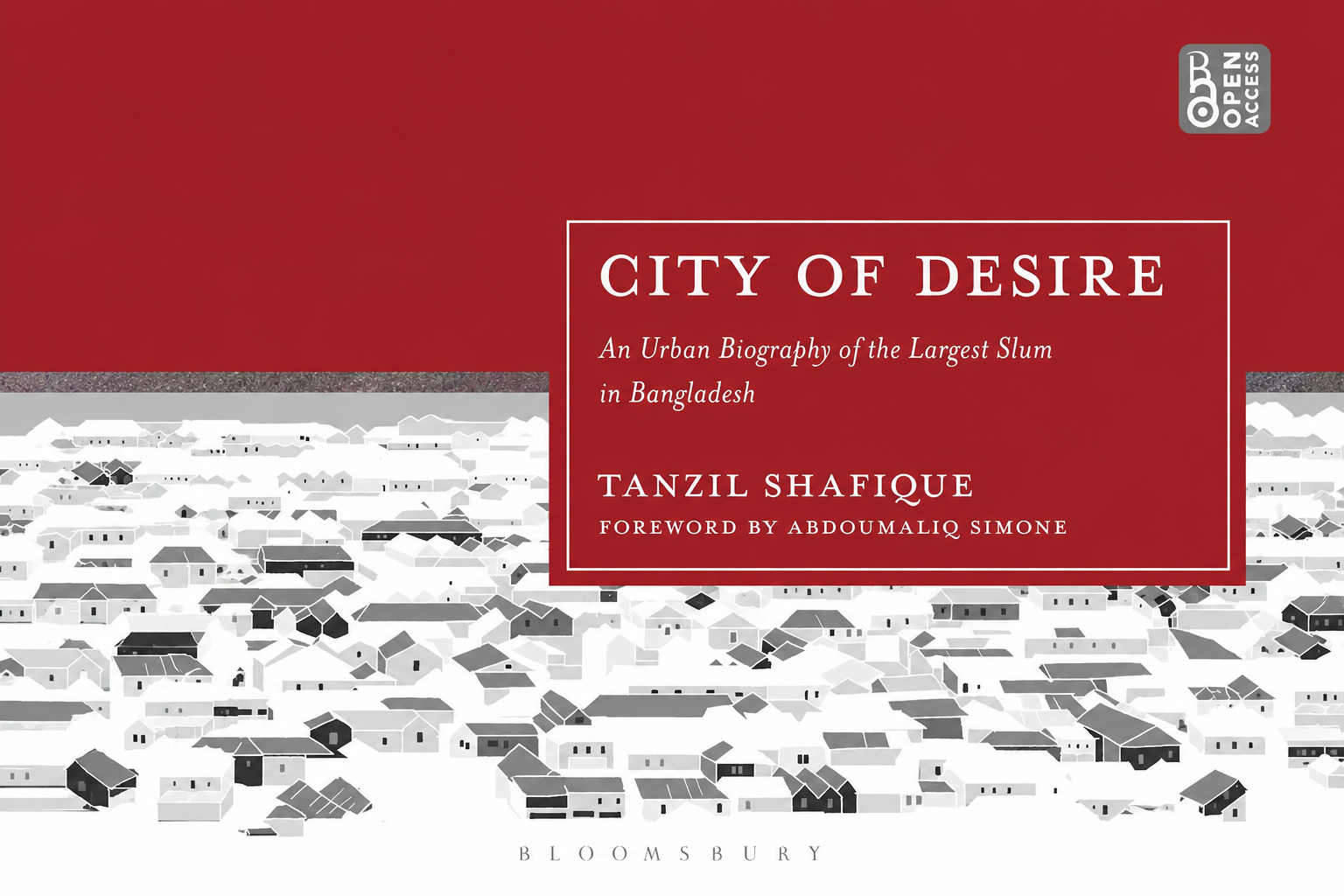
City of Desire
An Urban Biography of the Largest Slum in Bangladesh. A profound reflection on informality, everyday city-making, and the Qur’anic ethical horizon of ihsaan.
City of Desire: An Urban Biography of the Largest Slum in Bangladesh—my book has recently been published by Bloomsbury. Its publication has given me a moment to return to my long engagement with Korail and to think more carefully about what the work has been opening up beyond the immediate questions of informality, urban life, and everyday city-making. Increasingly, I see the book as having led me toward a Qur’anic ethical vocabulary—particularly the idea of ihsaan. Writing about Korail inevitably brought questions of dispossession, desire, care, uncertainty, neighbourliness, and survival into view.
It is not a formal review of my book, but a reflection prompted by its publication—an attempt to think through ihsaan as a Qur’anic horizon for reimagining cities, environmental repair, and climate justice. The book itself is dedicated to those rare leaders in settlements who assemble collective desires into everyday actions that make a city beautiful, “those with a desire to care, a desire for ihsaan.”
A City Within a City
Korail is not a peripheral settlement at the edge of Dhaka. This is important to say at the beginning. It sits in the middle of one of the most valuable parts of the city, beside Gulshan, Banani, and Mohakhali—areas associated with wealth, embassies, offices, hospitals, garments-related activity, domestic work, services, and middle-class life. Korail is surrounded by the formal city, yet it is repeatedly treated as if it should not be there.
It is visible and invisible at the same time: physically central, economically indispensable, politically precarious, and morally pushed to the margins. In the book, Korail is described as a “city within a city”: dense, walkable, productive, improvised, and continually under construction. Its residents have built housing, lanes, shops, religious spaces, services, social networks, and everyday infrastructures over decades, largely outside the formal apparatus of the state.
The scale also matters. Korail is often discussed as a “slum,” but that word quickly reduces the place to a condition of lack. It houses hundreds of thousands of people and is deeply connected to Dhaka’s urban economy. Many residents work in nearby affluent neighbourhoods as domestic workers, drivers, security guards, service workers, rickshaw pullers, shopkeepers, small traders, garment workers, repair workers, recyclers, and informal transport providers. The settlement allows low-income workers to live close to employment in a city where commuting is expensive, slow, and exhausting. It provides affordable housing where the formal market cannot. It absorbs migrants, including people displaced by poverty, rural precarity, river erosion, and climate-related pressures. In this sense, Korail is not outside the city. It is one of the mechanisms through which the city functions.
Yet Korail exists under the sign of uncertainty. The land is publicly owned, but it has been occupied, subdivided, rented, governed, negotiated, and transformed through complex arrangements among residents, local leaders, political actors, NGOs, service providers, and state agencies. Its tenure is insecure. It has faced repeated threats of eviction, redevelopment, resettlement, fire, and lake beautification projects. The surrounding lake, which creates both ecological possibility and political pressure, is central to this tension. To some, Korail appears as encroachment. To others, it is a place of refuge, labour, and life. To the state, it can appear as land awaiting development. To the people who live there, it is home, livelihood, memory, neighbourhood, risk, and future. This layered reality is what makes Korail so difficult to understand through a single language.
Beyond the Language of Lack
Korail is usually seen through the language of lack. Narrow lanes, tin-roofed rooms, uncertain water and electricity, fire, insecure tenure, political brokerage, state neglect, and the constant pressure of the lake and the city around it. These are real conditions. Any serious reading of Korail must begin by acknowledging them. Yet, if Korail is only understood through lack, something vital disappears. There is also an everyday affirmation of life. People repair homes, widen paths, negotiate access, create shops, build mosques, extend rooms, lend money, respond to emergencies, rebuild after fire, and sustain forms of social life that no formal plan has provided. Life in Korail is not merely endured; it is continually assembled. The city is made through small acts, repeated arrangements, partial solidarities, and improvised forms of care.
This is why I describe Korail as an urban biography rather than simply a case study. A case study often freezes a place in order to extract an argument. A biography allows the place to have a life, a history, a set of transformations, contradictions, intensities, and unresolved futures. Korail has changed over decades through land reclamation, densification, fire, rebuilding, service provision, political shifts, NGO interventions, local disputes, and everyday upgrades. A roof is fixed, a lane is paved, a room is added, a shop opens, a mosque expands, a drainage line appears, a wall is negotiated, a lake edge is reclaimed, a public toilet becomes something else. These small changes accumulate into a city-making process. They also reveal that informality is not the absence of order. It is another mode of ordering—one that emerges from social relations, scarcity, improvisation, and desire.
That is why the title City of Desire matters. People come to Korail to remain close to work, to keep children near schools, to remain within the economic life of Dhaka, to reassemble lives fractured by poverty, migration, river erosion, and climate pressure. The state also desires Korail: as land, as future development, as technological possibility, as lake beautification, as an image of a modern city. The market desires Korail through land value, labour, services, rent, transport, and recycling. Local leaders desire authority, recognition, control, sometimes protection, sometimes extraction. These many desires do not simply sit side by side; they push against each other, fold into each other, and produce the settlement as a constantly moving urban process.
Korail is therefore not an accidental disorder. It is a dense field of arrangements. It is made through formal and informal actors, visible and invisible rules, moral economies, political patronage, religious institutions, local leadership, fear of eviction, everyday cooperation, and the practical intelligence of residents. A lane may be narrow, but it is also a social space. A house may be temporary in material terms, but it may carry years of investment, memory, aspiration, and kinship. A shop may look small, but it can function as a credit system, information node, neighbourhood watch, and social meeting point. A mosque may be a place of prayer, but it also helps organise rhythm, sound, authority, gathering, and belonging. The lake may be an ecological system, but it is also a boundary, a danger, a livelihood edge, a political object, and a future claim.
Yet even this language of desire, power, and urban production leaves something unresolved. Korail can be read through informality, governance, state absence, infrastructural improvisation, land politics, ecology, and climate risk. All of these readings matter. But everyday life also produces something that exceeds obligation. A neighbour helps not because a contract requires it. A shopkeeper extends credit not because a policy mandates it. People gather after a fire not because a formal institution has instructed them to. Someone accompanies an injured child to hospital because social life itself carries a hidden ethic of response. This excess is not pure. It is not innocent. It sits within conflict, scarcity, brokerage, hierarchy, and survival. But it is real. It is one of the ways human life refuses to be reduced to administration.
From Justice to Ihsaan
This is where ihsaan becomes important. In Islamic ethics, adl—justice—is foundational. A society cannot stand without justice. Justice names harm. It demands accountability. It protects people from oppression. It creates the basis for rights, compensation, legal struggle, and political claims. It allows the harmed to speak. It asks who has been wronged, who is responsible, and what must be restored. But justice is a foundation, not the whole building. Ihsaan is the horizon that opens beyond the minimum.
Justice says: prevent harm. Ihsaan says: cultivate life. Justice says: give people their due. Ihsaan says: create the conditions in which dignity, care, belonging, repair, and beauty can grow.
This movement from justice to ihsaan is deeply Qur’anic. The Qur’an states: “Indeed, Allah commands justice, ihsaan, and giving to relatives…” (16:90). The pairing is crucial. Justice and ihsaan are not rivals. Justice is the necessary ground; ihsaan is the ethical intensification of that ground. Justice restrains zulm. Ihsaan nourishes social life beyond restraint. Justice can define what is owed. Ihsaan attends to what cannot be reduced to debt. Justice gives structure to rights. Ihsaan gives texture to relationships. In that sense, ihsaan is not an optional ornament added after politics. It is a Qur’anic grammar for how social life becomes more than a system of claims.
The Hadith of Jibril makes this even clearer. Islam, Iman, and Ihsan appear there as different but connected depths of the religious life. Ihsan is described as worshipping Allah as though one sees Him, and if one does not see Him, knowing that He sees us. This is often read as a spiritual or devotional definition, and rightly so. But its ethical implications are far wider. To live under divine witnessing is to act with an awareness that exceeds visibility, law, and social approval. It means that what is unseen still matters. The care no one counts matters. The repair that never appears in a report matters. The dignity preserved quietly matters. The generosity that leaves no institutional trace matters. Ihsaan, in this sense, is an ethic of divine visibility within human relations.
Al-Ghazali’s moral-spiritual tradition helps deepen this further. In the broad architecture of Ihya’ ‘Ulum al-Din, outward correctness is never enough by itself. The quality of an act depends on intention, adab, sincerity, humility, and the state of the heart. An action may be legally valid and still ethically thin. It may fulfil an obligation and still lack beauty. It may be technically correct and still fail to repair a relationship. Ghazali’s world reminds us that ethics is not only about whether an action can be justified, but what kind of person, relation, and world the action cultivates. Ihsaan therefore adds inward excellence to outward justice. It asks not only what was done, but how it was done, with what orientation, and toward what kind of life.
Ibn ʿArabī takes this into an even more expansive register. In the Fuṣūṣ al-Ḥikam, one of the “bezels” or “seals” of wisdom is associated with ihsaan in the word of Luqman. Luqman is a striking figure for this purpose. He is not presented in the Qur’an primarily as a ruler, warrior, or legal authority, but as a figure of wisdom, counsel, humility, tawhid, patience, prayer, and ethical formation. His wisdom appears in the intimate register of advice: how to walk, how to speak, how to be humble, how to remember Allah, how to live in relation. When ihsaan is read through Luqman, it becomes more than doing good deeds. It becomes a mode of wisdom: how to inhabit the world beautifully, how to speak without domination, how to guide without arrogance, how to cultivate ethical life through care rather than control.
Within Ibn ʿArabī’s wider metaphysics, reality itself is relational disclosure. Divine names appear in multiplicity: justice, mercy, beauty, generosity, gentleness, majesty, nearness. Human life becomes ethically meaningful when it reflects these names in partial, limited, situated ways. Ihsaan, then, is not simply moral kindness. It is a way of allowing beauty, generosity, and mercy to become socially operative. When a broken relation is repaired, when a vulnerable person is treated with dignity, when a place is made liveable rather than merely serviced, when a community is listened to rather than merely consulted, something of that ihsanic orientation becomes visible.
This matters for cities. Modern urban governance often speaks in the language of allocation, legality, entitlement, risk, consultation, compliance, and compensation. These are not useless words. They are often necessary. But they frequently produce a thin idea of justice. The “right to the city” becomes access to services rather than collective remaking of urban life. Participation becomes a procedural event rather than a transformation of power. Inclusion becomes being allowed into a system without changing the system that excluded people in the first place. In my KU Leuven presentation, I framed this as one of the limits of current spatial justice: justice becomes juridical, procedural, and technocratic, while deeper questions of care, dignity, ecological relation, and collective flourishing remain outside the frame.
Korail teaches another grammar. There, the city is not only what is formally delivered. It is what is assembled through relationships. A lane is not only a circulation route; it is encounter, surveillance, commerce, play, negotiation, and memory. A home is not only property; it is livelihood, reputation, kinship, aspiration, and fear. A mosque is not only a religious building; it is rhythm, gathering, announcement, authority, and social infrastructure. A lake is not only a water body or land-use category; it is livelihood, boundary, danger, possibility, ecology, and contested belonging. These realities do not abolish the need for justice. They show that justice must become capacious enough to hold the relational thickness of life.
Ihsaan helps name that thickness. It prevents us from reducing people to rights-bearing individuals alone, even while rights remain essential. It prevents us from reducing settlements to vulnerable sites, even while vulnerability remains real. It prevents us from reducing ecological repair to technical intervention, even while technical work remains necessary. It asks us to see people as relational beings, cities as shared life, land and water as amanah, and repair as an ethical practice that exceeds project delivery.
It asks the powerful to transform how they hold power. It asks institutions to move from consultation to listening, from delivery to stewardship, from accountability to amanah, from inclusion to belonging, from mitigation to repair. Ihsaan does not soften justice. It deepens justice.
Climate Justice and Relational Repair
This distinction becomes urgent in environmental and climate debates. Environmental justice has given us vital tools: who polluted, who suffered, who was displaced, who was compensated, who was excluded from decision-making. Climate justice has brought historical responsibility, loss and damage, adaptation finance, carbon accounting, and vulnerability into global politics. These are indispensable gains. But the language of climate justice also risks becoming trapped within funding architecture. A harmed community is asked to prove vulnerability. A damaged river is translated into metrics. A wetland becomes ecosystem service. A displaced family becomes a beneficiary count. A fractured life must become legible to donors, consultants, indicators, and reports.
That language brings money, recognition, and sometimes protection. It also narrows the imagination. It asks the harmed to translate their wounds into the grammar of those who hold the forms, funds, and decisions. It values what can be measured, costed, monitored, and reported. It often struggles to hold memory, dignity, loss of place, neighbourliness, spiritual relation, ecological intimacy, and the everyday labour of repair. Climate justice, at its best, opens the door to accountability. Climate ihsaan can push the conversation further toward relational repair.
Climate ihsaan does not replace climate justice. It completes and stretches it. Climate justice says: account for historical responsibility. Climate ihsaan says: rebuild the broken relationship with the Earth. Climate justice says: pay for loss and damage. Climate ihsaan says: repair the worlds that have been damaged. Climate justice says: include affected communities. Climate ihsaan says: recognise them as knowledge-holders, stewards, neighbours, and moral agents. Climate justice says: polluters owe compensation. Climate ihsaan says: polluters must also transform the extractive relation that produced the harm. Climate justice says: donors must finance adaptation. Climate ihsaan says: donors must also learn humility, listening, knowledge justice, and locally led transformation.
This is not a West versus non-West argument. That binary is too easy and increasingly unhelpful. Western modernity, colonialism, and fossil capitalism are deeply implicated in the climate crisis. That must be said clearly. But moral responsibility does not stop there. We are all implicated in different ways. Bangladeshi cities also fill wetlands. Our middle classes also erase Korail from their moral imagination. Our states also displace people in the name of development. Local elites also capture community language for power. Donors may use justice language while preserving their own authority. The point is not to replace one innocence with another. The point is to build a deeper ethical reckoning: who benefits, who decides, who speaks, who is silenced, who measures, who repairs, and what kind of world these arrangements keep producing.
A Qur’anic horizon gives a powerful vocabulary for this reckoning. The Earth is not only a resource; it is amanah. Human beings are not only consumers; they are responsible creatures. Water, soil, plants, birds, fish, neighbourhoods, and future generations are not externalities; they are part of a field of relation. Justice identifies where the relation has been broken. Ihsaan imagines how it may be repaired. Justice restrains harm. Ihsaan cultivates flourishing. Justice names the wound. Ihsaan asks what kind of life must now be nourished.
That is why the movement from Korail to climate justice feels natural to me. Korail sits beside a lake. It is shaped by water, labour, migration, poverty, aspiration, and ecological tension. If its residents are seen only as encroachers, the wetland cannot be understood. If ecological damage is ignored in the name of poverty, the future also cannot be understood. A more honest language holds people and water together. It sees settlement and birds, livelihoods and biodiversity, rights and responsibilities, housing and wetland repair, not as separate domains but as entangled relations. Wetland restoration then becomes more than ecological technique. It becomes stewardship, trusteeship, livelihood, dignity, and care. Climate adaptation becomes more than infrastructure. It becomes relationship repair.
City of Desire begins from Korail, but Korail is not the end point. Korail is a lens. Through that lens, one sees that people make cities not only through design, but through relationship; not only through need, but through desire; not only through rights, but through care. Everyday conviviality in Korail is not pure, harmonious, or conflict-free. It is crossed by injustice, exploitation, hierarchy, fear, and uncertainty. Yet it still contains a force that invites us to think beyond the minimum language of justice. That force needs a vocabulary. Ihsaan offers one such vocabulary.
This also allows us to revitalise terms that have become tired. Sustainability can become more than resource management when read through amanah. Resilience can become more than the capacity of the poor to endure when tied to dignity and collective support. Participation can move beyond presence toward shared decision-making. Inclusion can move beyond entry toward belonging. Climate justice can move beyond compensation toward repair and flourishing. Ihsaan does not discard these terms; it gives them ethical depth.
So the claim is simple, but its implications are demanding. Justice gives the language of harm; ihsaan gives the language of repair. Justice demands accountability; ihsaan deepens responsibility. Justice opens legal and political struggle; ihsaan asks what kind of world that struggle is trying to make possible. In the age of climate crisis, this difference matters. We need climate justice, but we also need a climate ethics that sees the Earth as amanah, affected people as knowledge-holders, wetlands as living relations, and repair as a moral and political task.
Korail has taught me that life is larger than the minimum conditions of justice. People are not only victims; they are city-makers, relationship-makers, and knowledge-holders. Wetlands are not only land; they are living relations. Climate politics is not only finance; it is moral repair. Before donors and polluters, we must certainly demand compensation. But we must also speak in our own ethical vocabulary and say: the world you have broken requires more than payment. It requires repair. It requires humility. It requires responsibility. It requires a different relation to life itself. Let justice be the beginning; let ihsaan open the horizon.


Comments