

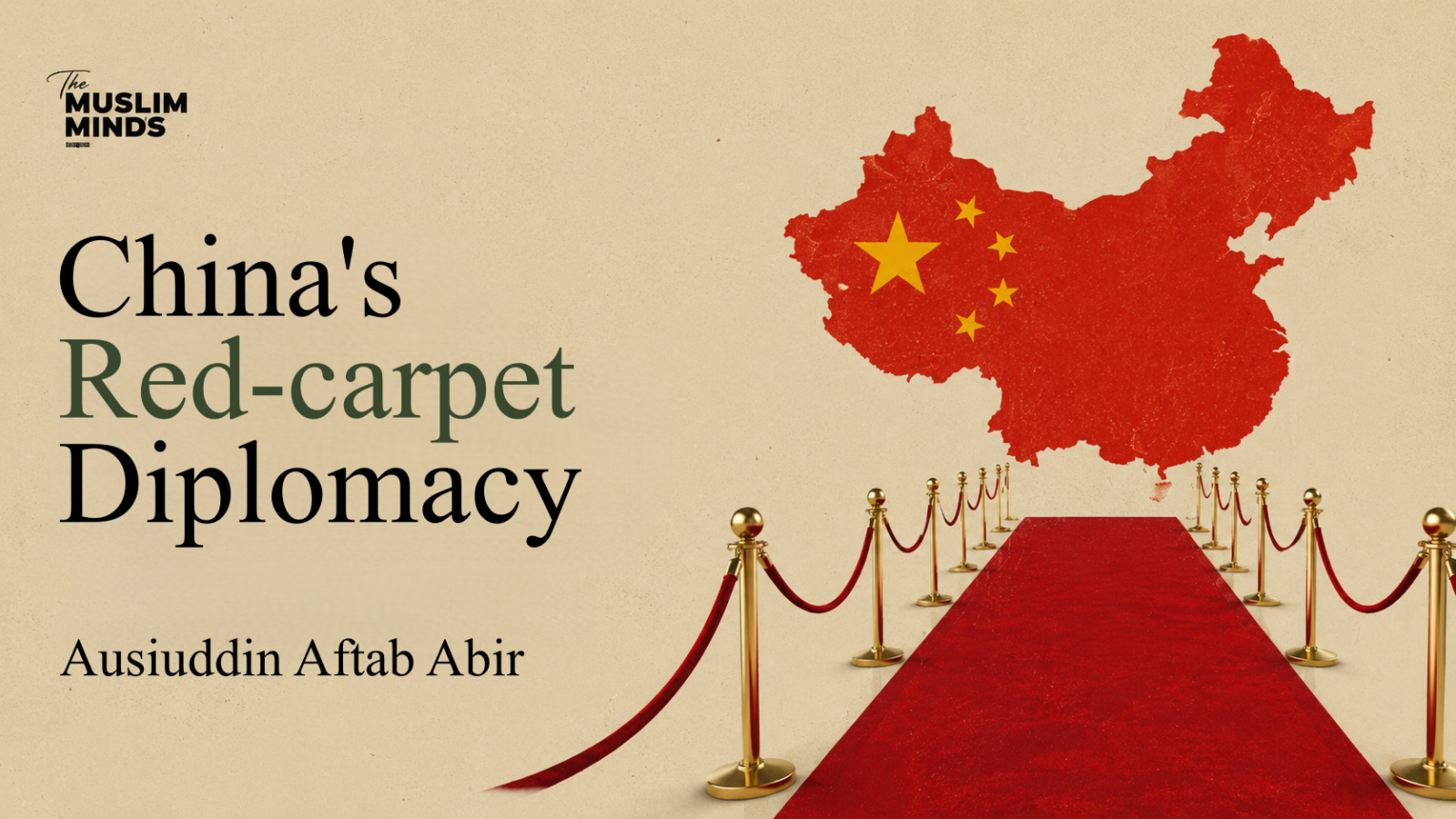
China's Red-Carpet Diplomacy
 Ausiuddin Aftab Abir9 min read
A New Order, Signed in Beijing
The red carpet in Tiananmen Square rarely folded up this year. Behind the joint communiqués and billion-dollar deals lies a quieter story: the silent shift of an emerging world order.
The red carpet in China’s Tiananmen Square rarely folded up as it hosted 26 global leaders from 23 countries in the last seven months. Most of these visits concluded with the signing of joint statements and the declaration of multibillion-dollar bilateral deals. The most recent visit, by Tarique Rahman, ended with a highly publicized, forward-looking 14-point joint communiqué that officially elevated their ties to a “Comprehensive Strategic Cooperative Partnership.” This pattern arguably signals a subtle shift in the global order. This article examines the geopolitical implications of China’s recent diplomatic engagement and assesses how it reflects Beijing’s vision of an emerging multipolar international order.
Prominent Visits and Major Outcomes
China hosted leaders from almost every region of the world. France’s Emmanuel Macron opened the cycle in December 2025, followed in January by Britain’s Keir Starmer, Canada’s Mark Carney, and South Korea’s president, who ended a nine-year hiatus in visits to China. Ireland and Finland’s leaders came soon after, as did Spain’s king, on his first trip in nearly two decades, and Prime Minister Pedro Sánchez, on his fourth visit in four years. Germany’s Friedrich Merz arrived ahead of European Union decisions on Chinese electric-vehicle tariffs. In May, the most significant visitors were U.S. President Donald Trump and Russian President Vladimir Putin. Pakistan’s Shehbaz Sharif and Serbia’s Aleksandar Vučić followed in late May. June brought Myanmar’s Min Aung Hlaing, Nepal’s foreign minister, and Bangladesh’s Prime Minister Tarique Rahman, alongside a BRICS security advisors’ meeting. By early June, Xi Jinping himself—barely leaving China all year—was content to host leaders from Europe, Asia, the Middle East, Africa, and America at his door.
Starmer’s visit produced a halving of Chinese tariffs on British whisky, visa-free travel for UK citizens, and a $15 billion investment pledge in China from AstraZeneca. Carney secured the lifting of Chinese tariffs on Canadian rapeseed. With Russia, Pakistan, and Myanmar, the agreements ran deeper into infrastructure financing, energy cooperation, and explicit alignment with Belt and Road and BRICS frameworks. Bangladesh’s Prime Minister Tarique Rahman concluded his June 26 visit to Beijing after the two sides announced a China–Bangladesh “community with a shared future in the new era,” while Bangladesh also signalled a desire for cooperation on infrastructure and economic-zone development. While China’s deals with Western countries focused on tactical agreements avoiding long-standing frictions, it built deeper integration with Russia and the Global South.
China’s deals with the West avoided old frictions. With Russia and the Global South, it built something deeper.
Implications of China’s Global Engagement
The impacts of China’s efforts to engage more with the world are far-reaching. In the immediate term, these visits eased market access for both parties, reduced geopolitical tensions, and revealed opportunities for greater growth. But they also carry economic, diplomatic, and strategic consequences for the interests of China. These are set out below.
Growing Sphere of China’s Economic Influence
China has developed an integrated economic ecosystem spanning raw-material sourcing, manufacturing, logistics, and consumption. As the world increasingly recognizes this scale and reach, more countries are deepening engagement with China to secure economic opportunities and strategic gains. China’s investment in ports, telecommunications, and technology has given it access to almost every region of the world. China is the major export destination for South America’s rare-earth minerals, Africa’s oil, and Asia’s marketplace, in exchange for their infrastructural development. Chinese brands’ share of the European electric-vehicle market has risen to roughly 15% as of early 2026, indicating an aggressive market policy. These countries also find China a large market for their consumer goods. This economic linkage encourages nations to secure economic interests in collaboration with China.
A New Dimension in Diplomacy
Western countries harbored an aversion toward China over the past two decades, an attitude generated mostly in Europe among states under U.S. influence. In the decades after the Second World War, Europe’s foreign policy was largely guided by American interests. However, recent diplomatic friction between Europe and its long-standing ally over tariffs, Ukraine-war policy, and NATO burden-sharing has opened a new dimension in European diplomacy. Recent visits from the leaders of the EU and states such as the UK, France, and Germany signal a quiet development in Europe’s approach. As a result, the visits are viewed as significant achievements for both China and Europe. Though Europe holds firmer opinions on global issues, a stable diplomatic connection with it would leverage China’s causes in global forums and serve Beijing’s economic ambitions.
China’s Pivotal Role in Global Stability
At present, the global landscape is undergoing complex changes affecting almost every region. Against this backdrop, Beijing claims to see itself as a pivotal actor in maintaining global stability. Given its enormous economic and military power—and its disputes with other nations over maritime claims—China has largely avoided active military expeditions, presenting itself as a promoter of dialogue and diplomacy over conflict. China has also reportedly provided crucial and calculated support to Russia and Iran to counter U.S. interference while avoiding direct escalation and confrontation. Besides, China’s massive share of worldwide manufacturing trade acts as a buffer against major geopolitical disruptions, ensuring stability over the long term.
Shaping Global Governance in a Multipolar World
The global order is experiencing a profound transformation as the post–Cold War unipolar moment gives way to a contested multipolarity. In this transition, China has emerged as a central player, advancing a suite of global governance frameworks—the Global Development Initiative, the Global Security Initiative, and the Global Civilization Initiative. China is exercising a proactive major-power responsibility while simultaneously deepening its involvement in multilateral institutions and regional organizations. It is also collaborating in technology, security, and economics with countries such as Russia, Indonesia, Turkey, and Saudi Arabia, which are themselves pursuing more independent foreign policies. These developments suggest that China is positioning itself as a leading advocate of an emerging multipolar international order, offering an alternative to the long-standing U.S.-led global system.
Beijing is no longer merely joining the global order. It is quietly offering an alternative to it.
Implications for South Asia and Bangladesh
South Asia holds geopolitical and economic importance to China because it secures vital trade routes and energy shipping lanes. China has emerged as the largest trading partner for several key nations in the region. Operating primarily through the Belt and Road Initiative and a “maritime silk road” strategy, Beijing provides critical loans and military supplies and invests heavily in developing infrastructure in nations such as Pakistan, Bangladesh, the Maldives, and Sri Lanka. China’s growing economic and military presence in the region aims to challenge India’s regional dominance and secure its critical supply routes. It also signals China’s intention to establish long-term political relations with the governments of the region.
Bangladesh is a key economic partner of China, hosting several major China-invested infrastructure and industrial projects. Prime Minister Tarique Rahman’s recent visit elevated ties to a Comprehensive Strategic Cooperative Partnership—a status that, in China’s regional practice, typically brings closer defence-industry cooperation, currency and trade facilitation measures, and priority access to Chinese financing. China has also agreed to support the Teesta River management project in Bangladesh, underscoring its push for deeper involvement in the region. Amid rising great-power competition in the Indo-Pacific, China’s simultaneous statement rejecting foreign interference in Bangladesh’s internal affairs was widely read as a signal to both India and the United States. It highlights the narrowing path Dhaka must navigate in balancing its diplomacy among three principal external powers. A stronger Dhaka–Beijing relationship will likely recalibrate the Indo-Pacific strategy of major powers in the coming decade.
For Dhaka, the red carpet comes with a narrowing path—balanced between three great powers, each watching the others.
Conclusion
The intensity of high-level visits reflects the way China is positioning itself within an increasingly multipolar international system. While countries continue to balance their relations with both China and the West, economic imperatives are driving deeper engagement with Beijing across regions and political divides. For China, these engagements strengthen its influence in global governance, trade, and strategic affairs without relying solely on military power. For South Asia, and particularly Bangladesh, the evolving relationship with China presents significant opportunities for economic development alongside the challenge of maintaining strategic balance among competing major powers. As global power dynamics continue to evolve, the outcomes of these diplomatic engagements are likely to shape regional alignments and the broader international order for years to come.







Comments