
America at 250: The Burden of Its Own Ideals
 তাহমিদ ইসলাম7 min read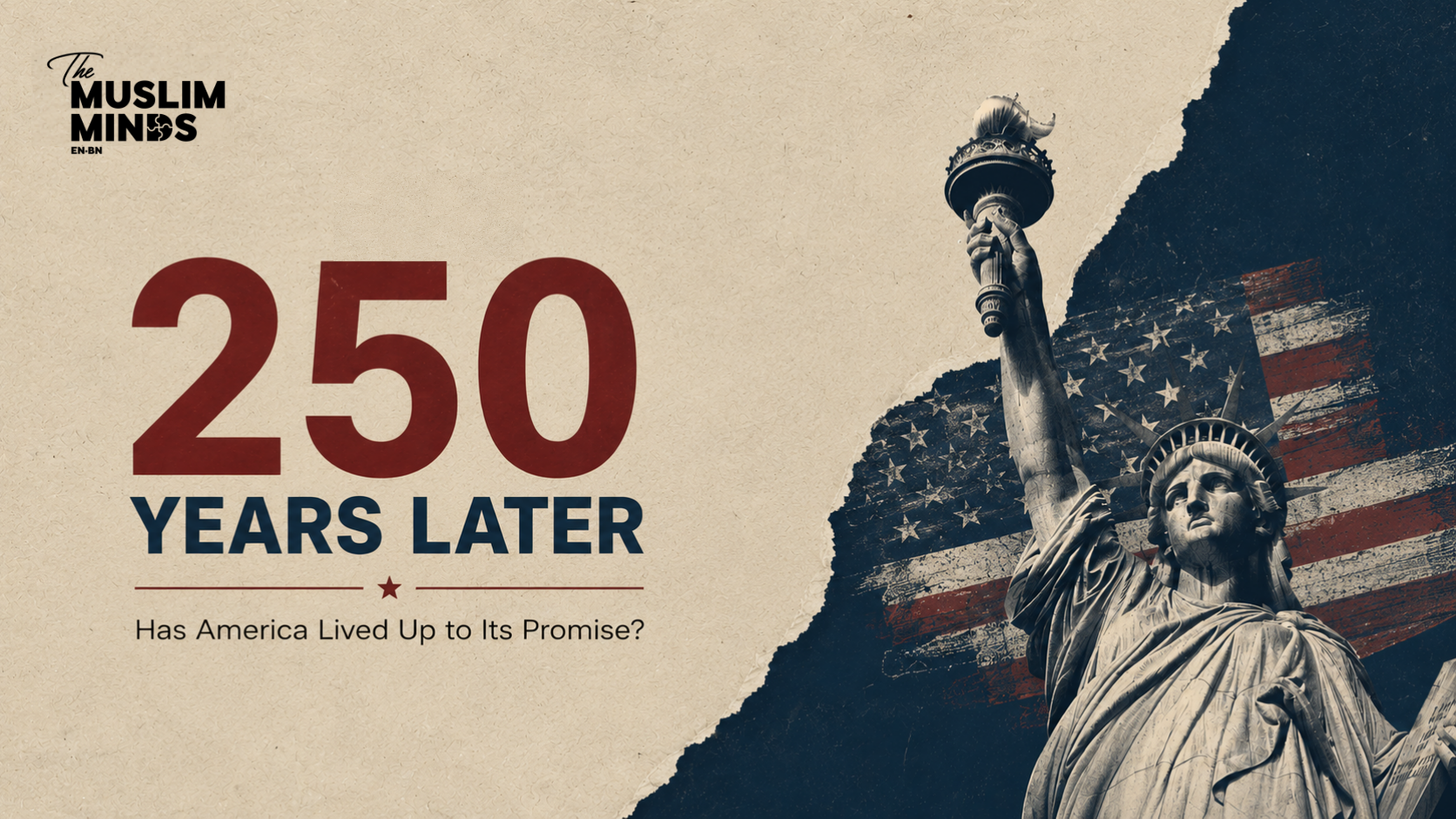
America at 250: The Burden of Its Own Ideals
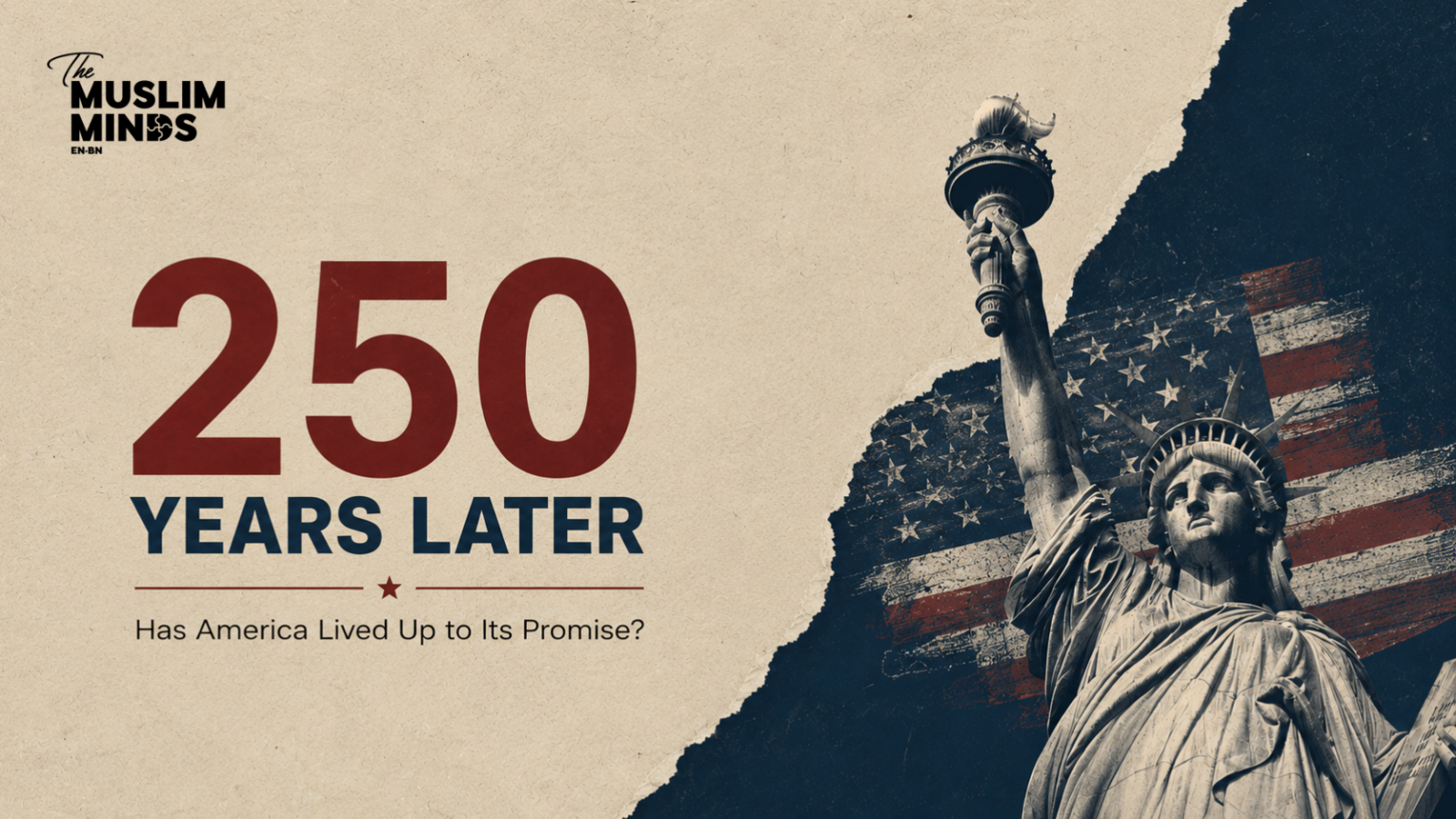
Can a nation founded on universal ideals ever escape the burden of failing to live up to them?
Every Fourth of July, America celebrates itself as the world’s oldest constitutional republic. Fireworks illuminate the sky, presidents invoke the Founding Fathers, and the familiar words of the Declaration of Independence echo once again: “All men are created equal.” Few declarations have travelled farther—or accumulated more contradictions—than those words. They have inspired revolutions, constitutional movements and struggles for freedom across the world. Yet, 250 years after they were first written, history demands a more uncomfortable question: were those ideals consistently practised, or were they too often employed as the moral language through which American power justified itself?
The Republic and Its Contradictions
The contradiction did not begin with the American empire. It began with the American Republic. In 1776, equality was proclaimed while slavery remained one of the economic foundations of the new nation. Thomas Jefferson, the principal author of the Declaration, owned enslaved people. Liberty was celebrated while Indigenous nations were steadily pushed from their ancestral lands. The United States was not born after resolving these contradictions; it was born carrying them. The promise of universal freedom and the reality of exclusion developed side by side from the very beginning.
American history is often presented as a continuous expansion of liberty. There is truth in that narrative. Slavery was abolished, women gained the right to vote, segregation was dismantled in law, and the Civil Rights Movement fundamentally transformed American society. Yet another history runs alongside it—a history that is often remembered less enthusiastically. It includes the Trail of Tears, Jim Crow, the destruction of Black Wall Street, the lynching of Emmett Till, and the assassinations of Martin Luther King Jr. and other leaders who demanded that America honour the very ideals it proclaimed. The struggle for equality in the United States was not a gift bestowed by the state; it was won through generations of resistance against the state and against entrenched structures of power. The contradiction endured because equality was treated less as an immediate political reality than as an aspirational ideal—one that successive generations invoked while repeatedly excluding new groups from its promise.
The United States was not born after resolving these contradictions. It was born carrying them.
The Language of Ideals, the Practice of Power
The contradiction became even more visible once the United States emerged as the dominant global power. Washington increasingly described its foreign policy in the language of democracy, freedom and human rights. Critics, however, have long argued that these ideals were often applied selectively, invoked with great moral certainty when they aligned with American strategic interests and quietly set aside when they did not. During the Cold War, the United States repeatedly supported authoritarian governments and military coups in the name of containing communism. Democratically elected governments in Iran (1953), Guatemala (1954), and Chile (1973) were undermined or overthrown with American support whenever they appeared to threaten strategic interests. In Latin America, Asia and the Middle East, geopolitical calculations frequently outweighed democratic principles. The language remained idealistic. The practice was often unmistakably realist.
Perhaps nowhere was this contradiction more visible than in war. Hiroshima and Nagasaki ushered in the nuclear age, causing the deaths of well over 200,000 people, the vast majority of them civilians. Vietnam became synonymous with napalm, Agent Orange and a war justified in the name of freedom but remembered by millions through unimaginable destruction. After the attacks of September 11, the United States launched the “Global War on Terror,” promising to defend liberty against extremism. Instead, the world witnessed Guantánamo Bay, Abu Ghraib, extraordinary rendition and the invasion of Iraq based on claims about weapons of mass destruction that were never found. Entire societies were destabilised in the name of security. The rhetoric remained one of liberation. The consequences were often occupation, displacement and death.
Defenders of these decisions argue that they were shaped by genuine security dilemmas, imperfect intelligence and the grim arithmetic of confronting rival powers—that statesmen chose among bad options rather than between good and evil. Critics dispute both the necessity and the arithmetic. That disagreement is not easily settled. But it does not dissolve the central problem: a nation that claims universal principles invites judgment by them, and cannot plead exceptional circumstance indefinitely without eroding the claim itself.
The Rules-Based Order and Its Exceptions
This pattern continues to shape the twenty-first century. Successive American administrations have presented the United States as the guardian of a rules-based international order. Yet critics point to repeated inconsistencies in the application of those rules. International law appears inviolable when violated by rivals, yet negotiable when American allies are involved. Human rights are championed as universal values, yet strategic partnerships have frequently survived allegations of severe abuses. For many across the Global South, this has created the perception that democracy and human rights function not only as moral principles but also as instruments of geopolitical legitimacy.
This matters because America’s influence has never rested solely on economic or military power. It has rested equally on the belief that its institutions embodied principles with universal appeal. The greater the distance between those principles and American conduct, the weaker that moral authority becomes. Empires can survive without admiration, but liberal international orders cannot.
Empires can survive without admiration. Liberal international orders cannot.
Nowhere is this perception more visible than in the Middle East. America’s longstanding military, diplomatic and financial support for Israel has led many observers to argue that Washington has become inseparable from one of the most consequential humanitarian and political crises of the twenty-first century. While American leaders continue to speak the language of human rights and international law, critics argue that their response to Palestinian suffering has exposed a profound inconsistency between principle and practice. Whether one agrees with that assessment or not, it has become increasingly difficult for the United States to persuade much of the world that its moral vocabulary is applied equally to friends and adversaries alike.
The Ledger That Does Not Balance
None of this means that America contributed nothing positive to the modern world. It produced extraordinary universities, scientific breakthroughs, technological innovation and constitutional ideas that inspired millions beyond its borders. It helped defeat fascism in Europe and became home to some of history’s most influential civil rights movements. But acknowledging these achievements cannot become an excuse for forgetting the immense human cost of American power. History is not an accounting exercise in which one achievement cancels one atrocity. The moon landing does not erase Hiroshima. Silicon Valley does not erase Iraq. The Civil Rights Act does not erase centuries of slavery. Nations, like individuals, must be judged by the entirety of their conduct, not merely by the chapters they choose to celebrate.
The moon landing does not erase Hiroshima. Silicon Valley does not erase Iraq.
Conclusion
At 250, America faces a choice that every great power eventually confronts. It can continue to see itself primarily through the mythology of its ideals, or it can confront the distance between those ideals and the realities created in their name. Great nations are not diminished by honest reflection; they are diminished by their refusal to reflect. Patriotism that cannot tolerate memory becomes mythology. And mythology has always been the most comfortable language of empire.
Perhaps the greatest question America should ask on its 250th birthday is not whether it remains the world’s most powerful nation. It is whether power without moral consistency can ever truly claim the language of liberty. Until that question is answered honestly, America’s greatest challenge will not be preserving its power, but preserving the credibility of the ideals from which that power first claimed its legitimacy.




Comments